Tuesday, March 3, 2009

Brenda's overnight trip to Tenom

I recently spent two wonderful weeks in Sabah. During the first week, I took the Food Tour offered by Adventure Study Tours and in the second week, I did several of their day trips. These included an overnight trip to Tenom, a two and a half hour drive south-east of Kota Kinabalu. This was an opportunity to see a different part of Sabah. To get to Tenom, we needed to cross the Crocker Range, the mountains that lie north-south in the country and include Mt Kinabalu. We went over an amazing road with wonderful views back towards the sea and with hair-raising road elevation inclines of up to 19 degrees. Fortunately Jude has driven this road a number of times and can do it without overheating the car!

Once we entered the valley on the other side of the mountains, we passed lots of padi fields that were at various stages of growth, some seeming to have just been planted, while others were ready to harvest. The journey took us through villages in which we could see traditional wooden houses on stilts.

In Tenom, the hotel we stayed at was perched precariously on the side of the mountains and has outstanding views back along the valley. From my hotel room window, I was able to watch a rainstorm come along the valley to Tenom. The storm clouds were beautiful!
Besides making the trip to Tenom itself, we wanted to visit the Sabah Agriculture Park with its huge array of fruit trees and many different plants, including an amazing collection of hybrid and native orchids. We spent a number of hours on two days, with a knowledgeable local guide, walking through the park, tasting fruit, learning about almost everything we looked at and taking innumerable pictures of plants and flowers. One of the highlights of the park is the restaurant. It is so beautifully situated, it's hard to describe! Just look at the picture of the scene we were looking at as we had lunch.
We went back to Kota Kinabalu on another new road for me, going through Tambunan and passing the Rafflesia Centre but there weren't any rafflesia in bloom - unfortunately. (Rafflesia is the world's largest flower.) The road went through rainforest as we crossed back over the Crocker Range and, as could perhaps be expected, it rained all the way! As far as I was concerned, this only enhanced my 'rainforest' experience.
This was the last day of the very active two weeks I had in Sabah. There is still so much to see that a return visit is definitely needed. Next time, perhaps the rafflesia will be in bloom, maybe I'll get to the islands, and to Sandakan and ...

Brenda Morgan, Calgary, Canada

If you have any questions about Brenda's trip or Sabah, please don't hesitate to write to us at: ron@astsabah.com and jude@astsabah.com. We'd love to hear from you!

Going to a Lotud Wedding - by Brenda Morgan

How fortunate I was to be here in Sabah for a real Lotud wedding! The nephew of the Manager of the Linangkit Cultural Centre (see the blog below Preserving traditions - a family venture) was getting married and I was invited through my connection with Ron and Jude. I had chosen to do the Food Tour with Adventure Study Tours and was lucky enough to be included in the wedding as well.

When we arrived at the Cultural Centre, we were warmly welcomed and taken straight into the area where the bride and groom were sitting on a dais. We were asked to sit on the floor - Ron went onto the stage with guests and local dignitaries and my friend and I sat down with the women in their beautiful traditional costumes. We were immediately surrounded by plates of traditional food which we ate with our fingers.


Meanwhile, the bride and groom were having photos taken with different groups of wedding guests. We were introduced and they asked us to have a photo taken with them as well.


My overwhelming impression was of the hospitality of these people who were going to entertain and feed over 800 guests during the course of a long day! Everyone wanted to know our names and where we were from and there was always someone with us to make sure we had something to eat and to fill our bowls with local brew. This is called 'bahar' and is a type of toddy or palm wine, made from coconut sap, fermented with special bark. We drank it from bowls, rather than glasses, and it was rather bitter with a strong alcohol taste. (The photo of Brenda drinking 'bahar' was taken by Consuelo Cardenas M. The others were taken by Brenda.)

The afternoon included a mixture of traditional and western-type entertainment. Firstly, there were young girls showing off their traditional dance skills to the accompaniment of gongs and drums and then the guests had a lot of fun with karaoke and line dancing. And everybody was involved: the bride and groom, the managers of the cultural centre, young and old - and even us!


The bride and grooom changed into western clothes during the course of the afternoon and then the dancing and karaoke carried on!

The food, the drink and the hospitality continued into the evening in the wonderful setting of the village.

As I think back to this day, my memory is of wonderfully hospitable people who seem to know so well how to have fun in a relaxed and comfortable way - in a really beautiful environment.


Brenda Morgan, Calgary, Canada

If you have any comments or questions about Sabah, please write to us at: ron@astsabah.com and jude@astsabah.com. We'd love to hear from you.

Monday, February 9, 2009

Photo opportunities at a water village

Sabah is an incredible place for photo opportunities and last year I visited a 'kampung air' (pronounced come-pong eye-yah) or water village near Kota Kinabalu that had plenty of superb photo ops. A 'kampung air' is where the houses are built on stilts over the water. Some of these villages are found along the coast, but the one we visited was up a river.
A small group of us went and Pam Sidhu (the one in the pink t-shirt) took most of these pictures. Our trip involved finding a small village that was accessible by road from which we could take a small boat to the kampung that was our goal. It was a pleasant trip along a sparsely settled river and relatively hassle-free. The boatman was really helpful, showing us around the kampung air when we got there and, in fact, at the end of our walk, he took us to his house, where we had a rest and a drink of water. A lot of the kampung air around Kota Kinabalu are settled by immigrants (both legal and illegal), as well as indigenous people. This village was home to the Bajau, a group famous for their fishing.
In this world of houses on water, there are completely different shadows, reflections and light. The houses seem fragile and rickety on their tiny legs, although the boardwalks between them are solid enough.
But, water village or not, life goes on as usual. Washing needs to be hung out to dry, older kids go to school while the younger ones hang around home and flash 'v' signs at visitors and everyone waits for the tide to come back in.
If you have any comments or questions about Sabah, please just send an email to one of us: ron@astsabah.com or jude@astsabah.com. We'd love to hear from you.

Wednesday, February 4, 2009

The Annual Big Market in Kota Belud

In October there is a 'Tamu Besar' or big market in Kota Belud, just a 40-minute drive north of Kota Kinabalu. It runs over two days, instead of the regular half-day Sunday market, and provides a real spectacle, especially on the second day.
Of course, you can't settle down to anything before you've had a drink and a snack and everywhere you go in Sabah, you can find fried bananas and local cakes. Nothing goes so well with a cup of coffee (or a glass of coffee - depends where you get it!). The bananas we had were being fried as we waited and were absolutely delicious - crunchy on the outside and then with that flash of banana in the middle.
And Kota Belud is wonderfully picturesque because it's so traditional. Look at the woman selling tobacco (in the middle of the pictures above). The tobacco is interesting, for one thing, and then her hat is just lovely! There were a lot of women wearing a variety of different hats - but I'm going to save those pictures for another time! We went to the Tamu Besar on both Saturday and Sunday - but Sunday afternoon was the Real Thing. This was when the Bajau horsemen were on display. They are really incredible. A visual feast! There is something so exotic - and somehow mediaeval - about the silk, the colours, the decoration of the horses. Wonderful! This is an event for local people - it's not put on for tourists - and so there are things we still need to learn about it. For example, the 150 or so horsemen did a lot of manoeuvres - concentric rings and that sort of thing - that they had obviously practised. They were directed by two older men and worked around a man who sat on his horse in the middle of the field - perhaps the local chief - who was accompanied by two young boys on their horses - perhaps his sons. As we make friends with people in Kota Belud, we will be able to learn more about this fabulous event - and then let you know!

If you have any questions or comments, please get in touch with either of us: ron@astsabah.com and jude@astsabah.com. We'd love to hear from you!

Saturday, November 22, 2008

Preserving traditions - a family venture

AST: Sabah is about to launch two more tours: the Peoples of Sabah and the Arts & Crafts Tour. It's always a lot of fun researching these, partly because of the wonderful people you meet and partly because of what you learn - and there is so much to learn here in Sabah!

I had been talking to someone about the possibility of having a mock traditional wedding as part of the Peoples Tour and she rang me to suggest that we visit Linangkit Cultural Village. This is an exciting new family-run project and it was fascinating to see what a professional, quality project it is. We really enjoyed meeting the friendly people there who are committed to preserving their culture and traditions - tourism being one way of doing this - as well as using this project as a way of motivating young people to value their heritage.

Most of the photos that I am using here have been kindly provided by Linangkit Cultural Village and were taken by Ceaser Jilan and Elvin Jilan, sons of the Managing Director, Alice Tee Jilan. Others were taken by me.

Linangkit Cultural Village is in a kampong (village) near Tuaran, about 30 minutes north of Kota Kinabalu. The ethnic group is Lotud, a branch of the Kadazandusun, but with a strong sense of their own uniqueness.

As I said above, what we found at Linangkit was a family who are passionate about their cultural traditions and heritage and willing to put their funds together to create this village. They are recording their culture in photos and videos and will use this material in the museum that is currently being built. So, for example, they are keeping photographic notes of all the rituals performed by their customary priestesses, from the preparations to the ceremonies themselves.
There is a concerted and conscious effort at Linangkit Cultural Village to not only preserve the culture and traditions of the Lotud, but also to pass them on to the next generation. So the children were practising playing the traditional instruments when we were there and they practise regularly! It was great to see them playing the gongs and drums.

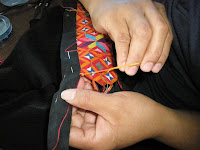
The name 'Linangkit' comes from the traditional knotted embroidery the Lotud do - as well as other groups in Sabah, such as the Rungus. It joins together the black sarong (skirt) that is part of the women's traditional costume. The piece being held here took Julita one and a half years to complete - working every day! When it was 3 and a half metres long, it went into the Malaysian Book of Records and she is working towards making it 20 metres long so that they can attempt to get it into the Guiness Book of Records.

And as for being able to include a mock traditional wedding in our Peoples tour, the answer is yes, we can! With a minimum number of 9 people in a group. Hmmm, I have local friends who would be interested in joining us as well...

If you have any comments, please email me at: jude@astsabah.com. And if you have any questions about Sabah or travelling here, I would love to hear from you!

Thursday, October 9, 2008

Truly weird and wonderful!

September was a fantastic month for me as I accompanied two photographers around Sabah. It gave me the chance to go back to so many of the places I really love - Sabah Agriculture Park in Tenom and Mt Kinabalu National Park, for example - as well as go to new places that are also really wonderful. These were mainly on the east coast of Sabah in Sandakan, on the Kinabatangan River and in Danum Valley (near Lahad Datu).
What I discovered was that there are some really weird plants out there - things that I have never seen in any books about Sabah! Well, a couple of them are.

Have a look at this flower:

It is in the books and it's called Amorphophallus paeoniifolius. Even its name is more than a mouthful! It stands about 30-40 cm high and just grows out of the ground with nothing else around it - reminiscent of rafflesia. It has a lovely colour and the large bit that sticks up is just like a semi-deflated (or semi-inflated) balloon. (Depends whether you're a half-empty or half-full person, I guess...) What a creation it is! It is supposed to have a strong, bad smell, but there didn't seem to be one when I was there. And this is another similarity it has with rafflesia.


And here's a close-up of a rafflesia. See the two flies? They are attracted by the rotten smell - but, again, I couldn't smell anything. Rafflesia have no roots, stems or leaves and the buds take 6-9 months to mature. They're quite difficult to find, so I've been lucky over the past couple of months to come across flowers in the Poring area.


The rafflesia have been studied in depth and you can buy books about them - but not the next two flowers! I've never seen anything like them. If you know what they are, please let me know!

This first one looks to me like something out of a science fiction movie - where they removed someone's brain and then attached it to something else to keep it alive (and I don't even like science fiction!). What do you think? It grows on a vine and is quite firm and papery to touch. Interesting colour - but look at the vein-like bits! As if you're looking at someone's very pale skin. Weird!

Then there's this next one. Attractive shape - like some regal, floating bird. But what is it? Please let me know if you have any idea. The elongated spoon-bill shape is appealing to me and so is the colour - but it's really strange! Again, it grows on a vine.


If you know anything at all about these fabulous plants, please let me know. You can email me at: jude@astsabah.com. And if you have any questions about Sabah or about our tours, please get in touch - I'd love to hear from you.

Sunday, October 5, 2008

Oaths, stones and black cockerels

In August, we were invited to a celebration to end a seminar about the rights of indigenous people. There is great concern about this in Sabah, as elsewhere in the world, and the hope that improvements will be made at the government level since the UN has provided a baseline with its Declaration on the Rights of Indigenous Peoples, adopted in September, 2007.

And what a sight the ceremony was that opened this day of celebration!

The priestesses (or Bobohizan) were there with their large, swaying headdresses, looking regal and focussed. The priest who led the ceremony seemed dignified, other-worldly and sensitive. His assistant, who kept a close watch on him, was more relaxed and grounded, somehow. Mind you, he was in charge of the rooster, holding it gently in his arms!

The ritual began with the priest muttering a long prayer at the peace rock which was planted in 1995 at the first celebration of Indigenous Peoples’ Day. He gave thanks for the UN Declaration of the Rights of Indigenous People and renewed the oath of those present to strive for peace. He spoke very quietly and everyone listened intently. There was no disturbance in this scene of black cloth, highlighted with gold and silver thread, coloured beads, twinkling buttons. The atmosphere was one of respect and timelessness.

After the prayer was finished, the priest and his assistant laid the rooster on the stone as a sacrifice. Its blood both cleansed the rock and reinforced the renewal of the oath to continue to strive for peace. The blood of the black cockerel spread thickly over the top of the rock. Later I was told that a bird used for this purpose cannot be eaten.


There are so many different thoughts that come to me at a ceremony like this. First of all, I feel that it’s a real privilege to be able to attend. Secondly, it’s wonderful to have this dynamic presence of tradition right here and now, being practised with such pride and dignity. Then come the concerns that I know are so real for the Kadazandusun about the future of the Bobohizan (female ritual specialists) that arise from the changes in people’s lives today - changes that impact on their attitude towards their own indigenous customs and practices. However, there is no doubt of the importance among the Kadazan people of maintaining their cultural knowledge and it is significant that there are individuals and organisations here in Sabah that are committed to doing that, such as the PACOS Trust. For more information about the Trust, have a look at their website (
http://www.sabah.net.my/PACOS/ ).

If you have any questions or comments, or you would like to find out about our tours in Sabah, please contact me at jude@astsabah.com. I look forward to hearing from you.