Showing posts with label traditional culture. Show all posts

Monday, October 26, 2009

Kota Belud's Annual Market - the Tamu Besar

Last weekend, a group of us went to the annual Big Market (Tamu Besar) in Kota Belud, a small town about 45 minutes' drive north of Kota Kinabalu. It's great going to the weekly Sunday market at any time - but this Big Market has an even livelier atmosphere and provides the background to the inevitable speeches, cultural performances and the selection of the young woman who represents the spirit of this event.

What caught my eye this time were the wrappings that were being used - such as folded and boiled leaves, some tied together and others fixed with toothpicks. They are all like magical bundles - what lies inside? And they feel so different from any of the wrappings we're used to dealing with. Then there's the golden glow of the batter that covers the freshly fried bananas draining over the wok. What could be more appetising!

I also enjoyed the lovely patterns made by the items on display - such as the drinks on sale with such 'interesting' colours that you even hesitate to try them! The bundles of local cigarette papers are beautifully done, as are the limes and rambutans displayed on the inevitable bit of newspaper in front of the woman selling them. The ikan bilis (or dried anchovies) are another tasty item on sale everywhere - great with cabbage!


The Kota Belud market is used to receiving a lot of visitors, so taking photos is not unusual. There are different reactions to it, of course, with some people preferring not to have their picture taken and others asking you to! The faces are etched with a life that we can hardly imagine and yet the smiles are all somehow the same! The different styles of head coverings are always a source of interest and I particularly like the traditional woven hats that are still worn a lot, although mainly by older women.

The highlight of the Tamu Besar is the display by the Bajau horsemen which is on the Sunday afternoon. The Bajau people form one of the larger groups of indigenous people in Sabah and most are Muslim. They have a tradition of keeping ponies and decorating them in a kind of mediaeval livery on special occasions. This year, to honour the 1 Malaysia theme, everyone who was riding also carried a full-sized flag. It was a wonderful sight! Children were put on the horses for the first time and little boys also tried on the traditional headdress. The horses looked incredible with even their ears covered - and many with a string of bells around their necks that sounded terrific as they moved around. As with the head coverings at the market, the men's headdresses can be done in a variety of ways, but they all look quite regal - even when the wearer gives the 'v' sign or the thumbs up in the picture!
The Tamu Besar was advertised as a two-day event so we decided to stay overnight at the Kota Belud Travelers' Lodge, which was fine. Very nice people working there. Not much happened on the first day, but that gave us time to wander around and try the many snacks that are on sale around the parade ground. The main events are held on the Sunday morning and afternoon. The speeches and cultural dances are held at the market place and then the display by the Bajau horsemen - and the buffalo races! - take place in the parade ground, a central field in the middle of town.

If you have any questions or comments, please send them to us at: jude@astsabah.com or ron@astsabah.com. We'd love to hear from you!

Friday, June 19, 2009

Malacca - design, colour, history, food

Griffin and I have just made a short trip to Malacca (Melaka), in West Malaysia. It is a place with a long, interesting history that includes Malays, Chinese, Indians, Portuguese, Dutch and, inevitably (somehow) British influences.
Perhaps it is the intermixing of all these cultures that has lead to such interesting decorative elements in Melaka - starting with the handmade beaded slippers that are made for Nyonya weddings (both the bride and the groom might wear them), as well as for other special occasions. In the photo, you can just glimpse the graph paper on which the design has been drawn. It is attached to the cloth and then each bead is hand sewn over it. Very beautiful work and with lots of wonderful designs.

Then there are the tiles found outside a lot of the old houses in the centre of Melaka. The ones for walking on are, of course, plainer and more utilitarian-looking than the ones that run along the bottom of the front wall of the house in various lovely colours and patterns.
If you stand back and look up, you are likely to see some very interesting ornamentation around the windows as well. Something like Melaka rococo? Such a fantastic combination of elements from both the west and the east.
Notice the vertical bar on the open window used to move the louvres up and down to regulate light and the breeze.

Not all the older houses in Melaka are well preserved but those that are provide a feast for the eyes. The usual house front is very narrow - about 21 feet - but this is made up for with the length of the house which can be up to 200 feet! The skyline created by the roofs of the houses was reminiscent of Hanoi in Vietnam. Wonder what created this kind of building? Taxes on the width of the house perhaps?

These particular houses are along the Melaka River that runs through the centre of the old town and creates its own special atmosphere, with people loitering on the bridges and lights glimmering in the water at night.

Melaka is also justly famous for its food, including the Nyonya cakes (the Nyonya people being a Malay-Chinese mix) and the rice porridge. This is eaten for lunch, rather than breakfast, and the basic rice soup is sharpened up with the addition of lots of extras, including small salted fish, eggs, pickles, fried onion, boiled chicken - in whatever combination you like! There's a huge cuisine in Melaka that we only just touched on. You could spend ages working your way through all the delicacies on offer. There seems to be an endless variety of cakes alone!
In the collage, you can see the varied opportunities there are in Melaka for photo-taking. It's a very picturesque place and the museum there gives a very full overview of Melaka's most interesting history.

If you have any comments or questions, please get in touch with us: ron@astsabah.com and jude@astsabah.com. We'd love to hear from you!

Thursday, June 4, 2009

Trying to be selective!

The Pesta Ka'amatan is now at an end - we'll have to wait another year for the next Harvest Festival. It's a wonderful month of celebration - and a real problem as far as photos go! I took a lot and just can't decide which ones to show you.

So have a look at these pictures that were all taken at the Heritage Village which is part of the Sabah Museum. During the first week of May, in particular, there were lots of activities going on in the traditional houses that are built around a lovely pond and up a hillside.
One of the moments that made me smile was seeing a woman fishing in the pond! She looked completely at home. (Top left) There was a house especially for weavers, embroiderers and beadmakers and they sat quietly getting on with their own work. Cloth, embroidery and beads were for sale. (2nd left top) In a replica of an old Chinese house, there were a couple making pots and carving them. It was lovely to see the young woman using the old pot as her model for the one she was working on. (3rd left top) And everywhere you went, you bumped into people wearing their traditional dress - so modestly and so proudly at the same time. (Top right) In a lot of houses, there were groups playing music and dancing, sometimes for visitors and sometimes for themselves. I tried using the local type of castanets that one group was using - not as easy as it looks - but a terrific sound. (Bottom right) And there's something elegant about the headdresses that sway as the wearer moves! (Bottom middle) Sometimes people just sat and watched what was going on - the same as I was doing! (Bottom left) In this second collage, you can see one of those elegant, totally confident older women you would love to get to know. (Top left) And there were a couple of friends who decided to sit outside, away from the air-conditioning, for a while. (Top middle) Then a beautiful pair of children who were very involved in the dancing and being taught carefully how to maintain their traditions. Just getting dressed correctly is something to learn! (Middle) On the right is a close up of the necklaces the young boy was wearing and the gold decorations on the front of his shirt. (Right) From the young to the old - we saw an old man do a very energetic dance, with foot stamping and arm waving! It was a privilege to see him. The younger people with him explained that he was the oldest person in their village to do this particular dance. (Bottom left) And finally, there's the humorous guy - he was sitting outside to have a smoke and you just wish you could talk to him and have a laugh together. (Centre bottom)

Pesta Ka'amatan - the Harvest Festival month - the month of May in Sabah. What a great time to be here! The high points of the festival are in the first week and the last two days of the month.

If you have any questions or comments, do write and let us know. Send a note to ron@astsabah.com or jude@astsabah.com. We'd love to hear from you!

Tuesday, May 12, 2009

May - Harvest Festival Month in Sabah!

Pest Ka'amatan is the Harvest Festival Month of May which stems from a tradition centred around rice and thanking the gods for a good harvest. This year the celebrations started in Papar, a small town about 40 minutes south of Kota Kinabalu.

The main ethnic group in Papar are the Kadazan. They were dressed in their finery for this day, looking wonderful from top to toe! Both men and women wear basic black velvet that is highlighted with gold buttons and braid. It looks stunning! You can see also that some women have frothy white blouses showing at the neckline and top their dress off with very finely woven hats that have fluffy decorations on top. Their hair is tied up in a scarf under the hat. The men wear a regal-looking headdress made from a square of hand-woven cloth that is rolled and folded into shape.
One of the wonderful aspects of these cultural events in Sabah is that everyone is involved - town folk and village folk, young and old. The children are involved in playing gongs, drums and bamboo flutes, as well as taking part in the dancing. And while it isn't unusual to see mixed groups of men and women playing gongs, this was the first time I had seen an all-woman gong team!

The festivities of the first week continued back in KK with a 'cultural extravaganza' put on by the Sabah Tourism Board (among others). This year the theme was 'Mystical Sabah' and the show was fantastic, involving 600 performers! My camera couldn't possibly do it justice!

But as well as that, there was a handicraft and food showcase where there were fascinating displays and demonstrations of local handicrafts from all over Sabah. The word 'demonstrations' isn't really accurate as these talented men and women were just carrying on with the work that they had brought from home! In the picture above, you can see one of the Papar hats being made from plant fibre. The woman making it is apparently the last one from that area who knows how to do it - but as people in Sabah are very aware of the importance of preserving and handing on their cultural traditions, I am sure that someone else will be learning. The fineness of the weaving in these hats has to be seen to be believed!
The woman on the left is embroidering a head cloth to be worn by a Rungus man. These are wonderful pieces of work as they are double-sided, in this case with yellow on one side and the usual black on the other, and richly worked.

Sitting next to her was a gong-maker from the same area and behind him you can see a completed head scarf.
These are only a few of the incredible artisans you can see in Sabah. On our tours, we go to a variety of Rungus villages north of Kota Kinabalu where there is a 'One Village One Industry' project and you can see these crafts being developed on a daily basis.
More later! If you have any questions or comments, please let us know at: ron@astsabah.com and jude@astsabah.com. We'd love to hear from you!


Posted by Picasa

Tuesday, April 7, 2009

The Murut Festival in Tenom - April 09

Plan your holiday in Sabah to include the Pesta Kalimaran of the Murut people - the third largest indigenous group here! It is held in Tenom every year in April. This year it was over the weekend of April 3-5. What an event! It was visually stunning - a kaleidoscope of colour. People were having a good time and there was a strong sense of vitality.
Going to a festival like this reminds me why I love Sabah so much. It's that 'Sabah style' with everyone being so welcoming, hospitable and inclusive. We were always being approached to introduce ourselves and people wanted to explain what was going on, especially on Sunday when they had the 'wedding' ceremony. They made sure we always had something to eat and drink and somewhere to sit. And where else could you ask your local MP to fill in a few minutes by singing a couple of songs to the huge audience?!?

The cultural performances included a gong competition, dance display and bamboo dance competition. There were interesting and informative displays, showing arts and crafts, as well as the clothing of the 7 different Murut ethnic groups. There was also a variety of stalls to look at and a range of food and drinks for sale. And even a ferris wheel!

The whole festival was professionally done and very well organised with events starting on time and introduced by very competent mcs. They even threw in the odd comment in English for the foreign guests - us!

Every year at this festival, they include a particular aspect of the traditional culture. This year it concerned the final dowry payment made by the husband's family to his wife's family. The couple get married after the dowry has been agreed, but the payments may happen in instalments and take years - even until grandchildren have been born! Nevertheless, when the final payment is made, it is a reason to have a feast. The gifts are accepted, speeches are given, songs are sung, the gongs are struck, the rice wine is drunk - and everyone has a great time. The payment can be in the form of cloth, ceramic jars, wine and strings of beads, for example.

It was the first time I had seen rice wine in the traditional tall jars, with the bamboo straws to drink from. The expectation is that you will drink until the level of the rice wine drops to the next red mark - an enormous amount to drink! I couldn't do it - even though the wine was delicious - but there were others who certainly could.

If you have any comments or questions, please just send an email to: ron@astsabah.com or jude@astsabah.com. We'd love to hear from you.

Tuesday, March 3, 2009

Going to a Lotud Wedding - by Brenda Morgan

How fortunate I was to be here in Sabah for a real Lotud wedding! The nephew of the Manager of the Linangkit Cultural Centre (see the blog below Preserving traditions - a family venture) was getting married and I was invited through my connection with Ron and Jude. I had chosen to do the Food Tour with Adventure Study Tours and was lucky enough to be included in the wedding as well.

When we arrived at the Cultural Centre, we were warmly welcomed and taken straight into the area where the bride and groom were sitting on a dais. We were asked to sit on the floor - Ron went onto the stage with guests and local dignitaries and my friend and I sat down with the women in their beautiful traditional costumes. We were immediately surrounded by plates of traditional food which we ate with our fingers.


Meanwhile, the bride and groom were having photos taken with different groups of wedding guests. We were introduced and they asked us to have a photo taken with them as well.


My overwhelming impression was of the hospitality of these people who were going to entertain and feed over 800 guests during the course of a long day! Everyone wanted to know our names and where we were from and there was always someone with us to make sure we had something to eat and to fill our bowls with local brew. This is called 'bahar' and is a type of toddy or palm wine, made from coconut sap, fermented with special bark. We drank it from bowls, rather than glasses, and it was rather bitter with a strong alcohol taste. (The photo of Brenda drinking 'bahar' was taken by Consuelo Cardenas M. The others were taken by Brenda.)

The afternoon included a mixture of traditional and western-type entertainment. Firstly, there were young girls showing off their traditional dance skills to the accompaniment of gongs and drums and then the guests had a lot of fun with karaoke and line dancing. And everybody was involved: the bride and groom, the managers of the cultural centre, young and old - and even us!


The bride and grooom changed into western clothes during the course of the afternoon and then the dancing and karaoke carried on!

The food, the drink and the hospitality continued into the evening in the wonderful setting of the village.

As I think back to this day, my memory is of wonderfully hospitable people who seem to know so well how to have fun in a relaxed and comfortable way - in a really beautiful environment.


Brenda Morgan, Calgary, Canada

If you have any comments or questions about Sabah, please write to us at: ron@astsabah.com and jude@astsabah.com. We'd love to hear from you.

Wednesday, February 4, 2009

The Annual Big Market in Kota Belud

In October there is a 'Tamu Besar' or big market in Kota Belud, just a 40-minute drive north of Kota Kinabalu. It runs over two days, instead of the regular half-day Sunday market, and provides a real spectacle, especially on the second day.
Of course, you can't settle down to anything before you've had a drink and a snack and everywhere you go in Sabah, you can find fried bananas and local cakes. Nothing goes so well with a cup of coffee (or a glass of coffee - depends where you get it!). The bananas we had were being fried as we waited and were absolutely delicious - crunchy on the outside and then with that flash of banana in the middle.
And Kota Belud is wonderfully picturesque because it's so traditional. Look at the woman selling tobacco (in the middle of the pictures above). The tobacco is interesting, for one thing, and then her hat is just lovely! There were a lot of women wearing a variety of different hats - but I'm going to save those pictures for another time! We went to the Tamu Besar on both Saturday and Sunday - but Sunday afternoon was the Real Thing. This was when the Bajau horsemen were on display. They are really incredible. A visual feast! There is something so exotic - and somehow mediaeval - about the silk, the colours, the decoration of the horses. Wonderful! This is an event for local people - it's not put on for tourists - and so there are things we still need to learn about it. For example, the 150 or so horsemen did a lot of manoeuvres - concentric rings and that sort of thing - that they had obviously practised. They were directed by two older men and worked around a man who sat on his horse in the middle of the field - perhaps the local chief - who was accompanied by two young boys on their horses - perhaps his sons. As we make friends with people in Kota Belud, we will be able to learn more about this fabulous event - and then let you know!

If you have any questions or comments, please get in touch with either of us: ron@astsabah.com and jude@astsabah.com. We'd love to hear from you!

Saturday, November 22, 2008

Preserving traditions - a family venture

AST: Sabah is about to launch two more tours: the Peoples of Sabah and the Arts & Crafts Tour. It's always a lot of fun researching these, partly because of the wonderful people you meet and partly because of what you learn - and there is so much to learn here in Sabah!

I had been talking to someone about the possibility of having a mock traditional wedding as part of the Peoples Tour and she rang me to suggest that we visit Linangkit Cultural Village. This is an exciting new family-run project and it was fascinating to see what a professional, quality project it is. We really enjoyed meeting the friendly people there who are committed to preserving their culture and traditions - tourism being one way of doing this - as well as using this project as a way of motivating young people to value their heritage.

Most of the photos that I am using here have been kindly provided by Linangkit Cultural Village and were taken by Ceaser Jilan and Elvin Jilan, sons of the Managing Director, Alice Tee Jilan. Others were taken by me.

Linangkit Cultural Village is in a kampong (village) near Tuaran, about 30 minutes north of Kota Kinabalu. The ethnic group is Lotud, a branch of the Kadazandusun, but with a strong sense of their own uniqueness.

As I said above, what we found at Linangkit was a family who are passionate about their cultural traditions and heritage and willing to put their funds together to create this village. They are recording their culture in photos and videos and will use this material in the museum that is currently being built. So, for example, they are keeping photographic notes of all the rituals performed by their customary priestesses, from the preparations to the ceremonies themselves.
There is a concerted and conscious effort at Linangkit Cultural Village to not only preserve the culture and traditions of the Lotud, but also to pass them on to the next generation. So the children were practising playing the traditional instruments when we were there and they practise regularly! It was great to see them playing the gongs and drums.

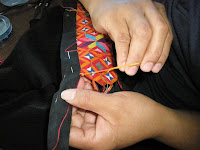
The name 'Linangkit' comes from the traditional knotted embroidery the Lotud do - as well as other groups in Sabah, such as the Rungus. It joins together the black sarong (skirt) that is part of the women's traditional costume. The piece being held here took Julita one and a half years to complete - working every day! When it was 3 and a half metres long, it went into the Malaysian Book of Records and she is working towards making it 20 metres long so that they can attempt to get it into the Guiness Book of Records.

And as for being able to include a mock traditional wedding in our Peoples tour, the answer is yes, we can! With a minimum number of 9 people in a group. Hmmm, I have local friends who would be interested in joining us as well...

If you have any comments, please email me at: jude@astsabah.com. And if you have any questions about Sabah or travelling here, I would love to hear from you!

Sunday, October 5, 2008

Oaths, stones and black cockerels

In August, we were invited to a celebration to end a seminar about the rights of indigenous people. There is great concern about this in Sabah, as elsewhere in the world, and the hope that improvements will be made at the government level since the UN has provided a baseline with its Declaration on the Rights of Indigenous Peoples, adopted in September, 2007.

And what a sight the ceremony was that opened this day of celebration!

The priestesses (or Bobohizan) were there with their large, swaying headdresses, looking regal and focussed. The priest who led the ceremony seemed dignified, other-worldly and sensitive. His assistant, who kept a close watch on him, was more relaxed and grounded, somehow. Mind you, he was in charge of the rooster, holding it gently in his arms!

The ritual began with the priest muttering a long prayer at the peace rock which was planted in 1995 at the first celebration of Indigenous Peoples’ Day. He gave thanks for the UN Declaration of the Rights of Indigenous People and renewed the oath of those present to strive for peace. He spoke very quietly and everyone listened intently. There was no disturbance in this scene of black cloth, highlighted with gold and silver thread, coloured beads, twinkling buttons. The atmosphere was one of respect and timelessness.

After the prayer was finished, the priest and his assistant laid the rooster on the stone as a sacrifice. Its blood both cleansed the rock and reinforced the renewal of the oath to continue to strive for peace. The blood of the black cockerel spread thickly over the top of the rock. Later I was told that a bird used for this purpose cannot be eaten.


There are so many different thoughts that come to me at a ceremony like this. First of all, I feel that it’s a real privilege to be able to attend. Secondly, it’s wonderful to have this dynamic presence of tradition right here and now, being practised with such pride and dignity. Then come the concerns that I know are so real for the Kadazandusun about the future of the Bobohizan (female ritual specialists) that arise from the changes in people’s lives today - changes that impact on their attitude towards their own indigenous customs and practices. However, there is no doubt of the importance among the Kadazan people of maintaining their cultural knowledge and it is significant that there are individuals and organisations here in Sabah that are committed to doing that, such as the PACOS Trust. For more information about the Trust, have a look at their website (
http://www.sabah.net.my/PACOS/ ).

If you have any questions or comments, or you would like to find out about our tours in Sabah, please contact me at jude@astsabah.com. I look forward to hearing from you.

Tuesday, May 20, 2008

Harvest Festival Month in Sabah!

May is when the whole of Sabah celebrates the Harvest Festival - the Tadau Kaamatan! There are celebrations involving dancing, singing and traditional games - as well as drinking rice wine (lihing).

The month kicks off with the Sabah Fest which has the theme of 'Harmony in Diversity' this year. And the grand concert which I attended at the beginning of the month really showed this. What a glittering display! The concert ended with more than 200 dancers gathered on stage. This is something that Sabah does very well. The traditional costumes were lovely - the dancers were young, energetic and enthusiastic - the music was an enticing mixture of gongs, drums, flutes and other local instruments - the atmosphere was delightful!

There were also some handicraft stalls set up where women were busy weaving cloth, hats and beads, as well as doing embroidery. I really love seeing these things - as well as having the opportunity to buy! The sarong in the picture is being held up by the woman who made it. The four points in the design are embroidered but the vertical join is actually done as series of tiny knots - a bit like tatting but done with a needle. Just beautiful! And the woman who made it (and sold it to me) was dressed beautifully as well. See what she had around her waist! She is from the indigenous group called the Rungus.

There is so much joy in the traditions here in Sabah - the dance, the customs, the handicrafts - and in the people themselves that events like the Pesta Kaamatan are really a lot of fun!

If you have any questions or comments, please send them to me at: jude@astsabah.com. I'd love to hear from you!