![]() |
| Cherry in the museum |
![]() |
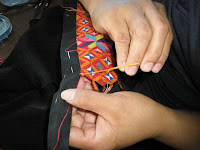
| Julita working on 'linangkit' |
![]() |
| Young & old play drums & gongs |
![]() |
| View of Linangkit Cultural Village |
![]() |
| Cherry in the museum |
![]() |
| Julita working on 'linangkit' |
![]() |
| Young & old play drums & gongs |
![]() |
| View of Linangkit Cultural Village |

What caught my eye this time were the wrappings that were being used - such as folded and boiled leaves, some tied together and others fixed with toothpicks. They are all like magical bundles - what lies inside? And they feel so different from any of the wrappings we're used to dealing with. Then there's the golden glow of the batter that covers the freshly fried bananas draining over the wok. What could be more appetising!
I also enjoyed the lovely patterns made by the items on display - such as the drinks on sale with such 'interesting' colours that you even hesitate to try them! The bundles of local cigarette papers are beautifully done, as are the limes and rambutans displayed on the inevitable bit of newspaper in front of the woman selling them. The ikan bilis (or dried anchovies) are another tasty item on sale everywhere - great with cabbage!
The Kota Belud market is used to receiving a lot of visitors, so taking photos is not unusual. There are different reactions to it, of course, with some people preferring not to have their picture taken and others asking you to! The faces are etched with a life that we can hardly imagine and yet the smiles are all somehow the same! The different styles of head coverings are always a source of interest and I particularly like the traditional woven hats that are still worn a lot, although mainly by older women.

In this second collage, you can see one of those elegant, totally confident older women you would love to get to know. (Top left) And there were a couple of friends who decided to sit outside, away from the air-conditioning, for a while. (Top middle) Then a beautiful pair of children who were very involved in the dancing and being taught carefully how to maintain their traditions. Just getting dressed correctly is something to learn! (Middle) On the right is a close up of the necklaces the young boy was wearing and the gold decorations on the front of his shirt. (Right) From the young to the old - we saw an old man do a very energetic dance, with foot stamping and arm waving! It was a privilege to see him. The younger people with him explained that he was the oldest person in their village to do this particular dance. (Bottom left) And finally, there's the humorous guy - he was sitting outside to have a smoke and you just wish you could talk to him and have a laugh together. (Centre bottom)
highlighted with gold buttons and braid. It looks stunning! You can see also that some women have frothy white blouses showing at the neckline and top their dress off with very finely woven hats that have fluffy decorations on top. Their hair is tied up in a scarf under the hat. The men wear a regal-looking headdress made from a square of hand-woven cloth that is rolled and folded into shape.
Going to a festival like this reminds me why I love Sabah so much. It's that 'Sabah style' with everyone being so welcoming, hospitable and inclusive. We were always being approached to introduce ourselves and people wanted to explain what was going on, especially on Sunday when they had the 'wedding' ceremony. They made sure we always had something to eat and drink and somewhere to sit. And where else could you ask your local MP to fill in a few minutes by singing a couple of songs to the huge audience?!?
The whole festival was professionally done and very well organised with events starting on time and introduced by very competent mcs. They even threw in the odd comment in English for the foreign guests - us! 
If you have any comments or questions, please just send an email to: ron@astsabah.com or jude@astsabah.com. We'd love to hear from you.
When we arrived at the Cultural Centre, we were warmly welcomed and taken straight into the area where the bride and groom were sitting on a dais. We were asked to sit on the floor - Ron went onto the stage with guests and local dignitaries and my friend and I sat down with the women in their beautiful traditional costumes. We were immediately surrounded by plates of traditional food which we ate with our fingers.
Meanwhile, the bride and groom were having photos taken with different groups of wedding guests. We were introduced and they asked us to have a photo taken with them as well.
My overwhelming impression was of the hospitality of these people who were going to entertain and feed over 800 guests during the course of a long day! Everyone wanted to know our names and where we were from and there was always someone with us to make sure we had something to eat and to fill our bowls with local brew. This is called 'bahar' and is a type of toddy or palm wine, made from coconut sap, fermented with special bark. We drank it from bowls, rather than glasses, and it was rather bitter with a strong alcohol taste. (The photo of Brenda drinking 'bahar' was taken by Consuelo Cardenas M. The others were taken by Brenda.)
The bride and grooom changed into western clothes during the course of the afternoon and then the dancing and karaoke carried on!
The food, the drink and the hospitality continued into the evening in the wonderful setting of the village.
As I think back to this day, my memory is of wonderfully hospitable people who seem to know so well how to have fun in a relaxed and comfortable way - in a really beautiful environment.
In October there is a 'Tamu Besar' or big market in Kota Belud, just a 40-minute drive north of Kota Kinabalu. It runs over two days, instead of the regular half-day Sunday market, and provides a real spectacle, especially on the second day.
unch two more tours: the Peoples of Sabah and the Arts & Crafts Tour. It's always a lot of fun researching these, partly because of the wonderful people you meet and partly because of what you learn - and there is so much to learn here in Sabah!
s that I am using here have been kindly provided by Linangkit Cultural Village and were taken by Ceaser Jilan and Elvin Jilan, sons of the Managing Director, Alice Tee Jilan. Others were taken by me.
as a family who are passionate about their cultural traditions and heritage and willing to put their funds together to create this village. They are recording their culture in photos and videos and will use this material in the museum that is currently being built. So, for example, they are keeping photographic notes of all the rituals performed by their customary priestesses, from the preparations to the ceremonies themselves.
And as for being able to include a mock traditional wedding in our Peoples tour, the answer is yes, we can! With a minimum number of 9 people in a group. Hmmm, I have local friends who would be interested in joining us as well...