Showing posts with label handicrafts. Show all posts

Friday, February 18, 2011

Linangkit Cultural Village - by Cherry and Mac

One of the highlights of our visit to Sabah was the afternoon we spent at Linangkit Cultural Village. This collection of traditional buildings has been set up by a small group of individuals keen to preserve their cultural heritage in a rapidly modernising society.
The visit starts with the removal of shoes and ceremonial washing of feet before entering the small museum by our guide and curator, an erstwhile engineering student, now full-time front man of the enterprise.
Cherry in the museum
The museum's most memorable exhibits were some shrunken heads, some huge Chinese storage jars, adopted as ritual objects by the tribespeople and a full tribal costume, complete with embroidered jacket and hooped belt which the tourist can try on.
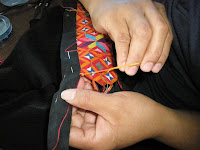
Julita working on 'linangkit'
The distinctive tribal textile tradition is kept alive by Julita  who keeps her brightly coloured threads in a clear plastic tool box for easy identification.  
Young & old play drums & gongs
Our visit culminated in a traditional meal served in the large and airy function room, built over the river, to provide a natural cooling system. Some younger members of the group appeared in costume and played the traditional gongs, whilst we ate ‘hinata’ (raw fish) and drank the local brew or freshly prepared tea. The village also boasts a small fish farm and is planning some small-scale purpose-built tourist accommodation with additional restaurant facilities. 

View of Linangkit Cultural Village
This was written by Cherry Taylor and the photos were taken by Mac Campeanu.  You can see more of his photos on:  http://gallery.me.com/campeanu#100099&view=grid&bgcolor=black&sel=59

If you have any comments or questions, please just write to me at:  jude@astsabah.com.  I'd love to hear from you. 

Friday, January 22, 2010

KK - coming of age

Kota Kinabalu is a great place to live. There is a lot going on here, a lot of new developments, a lot of different events happening all the time. The trick is to be able to find out about them! So you have to get onto people's mailing lists or sms lists - or join societies - or talk to people a lot about what you are interested in so that they remember to tell you when something is coming up!

And there is a new generation now making its mark in KK, so we see the cybercafes and the smart coffee shops and ice cream parlours and the trendy small restaurants with their fusion cuisine. Oh to be wanted to be seen! But I'm long past that. And I prefer the traditional small 'kopi tiams' (coffee shops), anyway.

However, I was sent an invitation to the opening of an art gallery in KK and I went there yesterday. What a great place - the Mary James Art Gallery! And just being there reminded me about how the young people of KK are having their influence on the city, shaping the look and feel of public places and happenings. The works on display also brought home to me again how profoundly artists in Sabah are influenced by the traditional cultures and handicrafts, the landscape, flora and Mt Kinabalu - hence my choice of photos for this blog! It is this link that underlies the design of AST's Flora Tour, where we explore what nature here offers and how this is so often the inspiration for artists (See our tours on www.astsabah.com)

Three Sabahan artists are being featured at the gallery at the moment. They are Awang Fadilah Bin Ali Hussein, Muhammed Amin B Muhidin and Sia Yek Chung. Their work is very different from each other's and very distinctive. Awang Fadilah works in acrylic and his black and white pictures are so full of fine detail that you are constantly seeing new things in them. Muhammed Amin, on the other hand, creates fabulous batiks on silk. They are vibrant and multi-layered, so that, again, their message is not revealed all at once - you need to keep looking at them to see what else is there.

Or you need to hear some of the stories that Ellie Hwong, the Managing Director of the gallery, can tell you about the pictures and the artists. She is committed to both the works and the artists and it is very interesting talking to her.

The third artist whose work is featured in the Mary James Art Gallery is Sia Yek Ching. He works in watercolour and the paintings on display are of pitcher plants, koi (fish) and local handicrafts. His super-enlarged pitcher plants are quite lovely.

In all three artists, the influence of Sabah is obvious, as I said above. The colours, the motifs, the themes, the richness of the cultures here and the unique offerings of nature in Sabah are all there in their work! I am not an artist myself - but I love looking at it, appreciating it and, occasionally, buying it! And all the works on display are very interesting to just look at and enjoy.

The works are all on sale and cater to the high-end and corporate slice of the market. Ellie is committed to promoting the work of Sabahan artists, though, and we look forward to some more exhibitions and perhaps 'meet the artist' evenings at this lovely new art gallery in KK.


You can visit the Mary James Art Gallery blog to see some of the works currently on display: http://mjartgallery.blogspot.com/. You can also call (088) 270223 for a viewing at the gallery.
If you have any comments or questions, don't hesitate to get in touch with us at: ron@astsabah.com or jude@astsabah.com. We'd love to hear from you!

Thursday, June 4, 2009

Trying to be selective!

The Pesta Ka'amatan is now at an end - we'll have to wait another year for the next Harvest Festival. It's a wonderful month of celebration - and a real problem as far as photos go! I took a lot and just can't decide which ones to show you.

So have a look at these pictures that were all taken at the Heritage Village which is part of the Sabah Museum. During the first week of May, in particular, there were lots of activities going on in the traditional houses that are built around a lovely pond and up a hillside.
One of the moments that made me smile was seeing a woman fishing in the pond! She looked completely at home. (Top left) There was a house especially for weavers, embroiderers and beadmakers and they sat quietly getting on with their own work. Cloth, embroidery and beads were for sale. (2nd left top) In a replica of an old Chinese house, there were a couple making pots and carving them. It was lovely to see the young woman using the old pot as her model for the one she was working on. (3rd left top) And everywhere you went, you bumped into people wearing their traditional dress - so modestly and so proudly at the same time. (Top right) In a lot of houses, there were groups playing music and dancing, sometimes for visitors and sometimes for themselves. I tried using the local type of castanets that one group was using - not as easy as it looks - but a terrific sound. (Bottom right) And there's something elegant about the headdresses that sway as the wearer moves! (Bottom middle) Sometimes people just sat and watched what was going on - the same as I was doing! (Bottom left) In this second collage, you can see one of those elegant, totally confident older women you would love to get to know. (Top left) And there were a couple of friends who decided to sit outside, away from the air-conditioning, for a while. (Top middle) Then a beautiful pair of children who were very involved in the dancing and being taught carefully how to maintain their traditions. Just getting dressed correctly is something to learn! (Middle) On the right is a close up of the necklaces the young boy was wearing and the gold decorations on the front of his shirt. (Right) From the young to the old - we saw an old man do a very energetic dance, with foot stamping and arm waving! It was a privilege to see him. The younger people with him explained that he was the oldest person in their village to do this particular dance. (Bottom left) And finally, there's the humorous guy - he was sitting outside to have a smoke and you just wish you could talk to him and have a laugh together. (Centre bottom)

Pesta Ka'amatan - the Harvest Festival month - the month of May in Sabah. What a great time to be here! The high points of the festival are in the first week and the last two days of the month.

If you have any questions or comments, do write and let us know. Send a note to ron@astsabah.com or jude@astsabah.com. We'd love to hear from you!

Tuesday, May 12, 2009

May - Harvest Festival Month in Sabah!

Pest Ka'amatan is the Harvest Festival Month of May which stems from a tradition centred around rice and thanking the gods for a good harvest. This year the celebrations started in Papar, a small town about 40 minutes south of Kota Kinabalu.

The main ethnic group in Papar are the Kadazan. They were dressed in their finery for this day, looking wonderful from top to toe! Both men and women wear basic black velvet that is highlighted with gold buttons and braid. It looks stunning! You can see also that some women have frothy white blouses showing at the neckline and top their dress off with very finely woven hats that have fluffy decorations on top. Their hair is tied up in a scarf under the hat. The men wear a regal-looking headdress made from a square of hand-woven cloth that is rolled and folded into shape.
One of the wonderful aspects of these cultural events in Sabah is that everyone is involved - town folk and village folk, young and old. The children are involved in playing gongs, drums and bamboo flutes, as well as taking part in the dancing. And while it isn't unusual to see mixed groups of men and women playing gongs, this was the first time I had seen an all-woman gong team!

The festivities of the first week continued back in KK with a 'cultural extravaganza' put on by the Sabah Tourism Board (among others). This year the theme was 'Mystical Sabah' and the show was fantastic, involving 600 performers! My camera couldn't possibly do it justice!

But as well as that, there was a handicraft and food showcase where there were fascinating displays and demonstrations of local handicrafts from all over Sabah. The word 'demonstrations' isn't really accurate as these talented men and women were just carrying on with the work that they had brought from home! In the picture above, you can see one of the Papar hats being made from plant fibre. The woman making it is apparently the last one from that area who knows how to do it - but as people in Sabah are very aware of the importance of preserving and handing on their cultural traditions, I am sure that someone else will be learning. The fineness of the weaving in these hats has to be seen to be believed!
The woman on the left is embroidering a head cloth to be worn by a Rungus man. These are wonderful pieces of work as they are double-sided, in this case with yellow on one side and the usual black on the other, and richly worked.

Sitting next to her was a gong-maker from the same area and behind him you can see a completed head scarf.
These are only a few of the incredible artisans you can see in Sabah. On our tours, we go to a variety of Rungus villages north of Kota Kinabalu where there is a 'One Village One Industry' project and you can see these crafts being developed on a daily basis.
More later! If you have any questions or comments, please let us know at: ron@astsabah.com and jude@astsabah.com. We'd love to hear from you!


Posted by Picasa

Saturday, November 22, 2008

Preserving traditions - a family venture

AST: Sabah is about to launch two more tours: the Peoples of Sabah and the Arts & Crafts Tour. It's always a lot of fun researching these, partly because of the wonderful people you meet and partly because of what you learn - and there is so much to learn here in Sabah!

I had been talking to someone about the possibility of having a mock traditional wedding as part of the Peoples Tour and she rang me to suggest that we visit Linangkit Cultural Village. This is an exciting new family-run project and it was fascinating to see what a professional, quality project it is. We really enjoyed meeting the friendly people there who are committed to preserving their culture and traditions - tourism being one way of doing this - as well as using this project as a way of motivating young people to value their heritage.

Most of the photos that I am using here have been kindly provided by Linangkit Cultural Village and were taken by Ceaser Jilan and Elvin Jilan, sons of the Managing Director, Alice Tee Jilan. Others were taken by me.

Linangkit Cultural Village is in a kampong (village) near Tuaran, about 30 minutes north of Kota Kinabalu. The ethnic group is Lotud, a branch of the Kadazandusun, but with a strong sense of their own uniqueness.

As I said above, what we found at Linangkit was a family who are passionate about their cultural traditions and heritage and willing to put their funds together to create this village. They are recording their culture in photos and videos and will use this material in the museum that is currently being built. So, for example, they are keeping photographic notes of all the rituals performed by their customary priestesses, from the preparations to the ceremonies themselves.
There is a concerted and conscious effort at Linangkit Cultural Village to not only preserve the culture and traditions of the Lotud, but also to pass them on to the next generation. So the children were practising playing the traditional instruments when we were there and they practise regularly! It was great to see them playing the gongs and drums.

The name 'Linangkit' comes from the traditional knotted embroidery the Lotud do - as well as other groups in Sabah, such as the Rungus. It joins together the black sarong (skirt) that is part of the women's traditional costume. The piece being held here took Julita one and a half years to complete - working every day! When it was 3 and a half metres long, it went into the Malaysian Book of Records and she is working towards making it 20 metres long so that they can attempt to get it into the Guiness Book of Records.

And as for being able to include a mock traditional wedding in our Peoples tour, the answer is yes, we can! With a minimum number of 9 people in a group. Hmmm, I have local friends who would be interested in joining us as well...

If you have any comments, please email me at: jude@astsabah.com. And if you have any questions about Sabah or travelling here, I would love to hear from you!

Tuesday, May 20, 2008

Harvest Festival Month in Sabah!

May is when the whole of Sabah celebrates the Harvest Festival - the Tadau Kaamatan! There are celebrations involving dancing, singing and traditional games - as well as drinking rice wine (lihing).

The month kicks off with the Sabah Fest which has the theme of 'Harmony in Diversity' this year. And the grand concert which I attended at the beginning of the month really showed this. What a glittering display! The concert ended with more than 200 dancers gathered on stage. This is something that Sabah does very well. The traditional costumes were lovely - the dancers were young, energetic and enthusiastic - the music was an enticing mixture of gongs, drums, flutes and other local instruments - the atmosphere was delightful!

There were also some handicraft stalls set up where women were busy weaving cloth, hats and beads, as well as doing embroidery. I really love seeing these things - as well as having the opportunity to buy! The sarong in the picture is being held up by the woman who made it. The four points in the design are embroidered but the vertical join is actually done as series of tiny knots - a bit like tatting but done with a needle. Just beautiful! And the woman who made it (and sold it to me) was dressed beautifully as well. See what she had around her waist! She is from the indigenous group called the Rungus.

There is so much joy in the traditions here in Sabah - the dance, the customs, the handicrafts - and in the people themselves that events like the Pesta Kaamatan are really a lot of fun!

If you have any questions or comments, please send them to me at: jude@astsabah.com. I'd love to hear from you!